Thursday, 2 November 2017

Martin Landau on His Relationship With Marilyn Monroe, Playing Gay for Hitchcock, and His Oscars Triumph
For Martin Landau, the turning point came when he found himself watching the 1984 Academy Awards, “having a beer in my underwear, saying: ‘I should be there.’”
In 2012, Landau—then 84—recalled this to me in an interview for the Times of London as the moment he knew he wanted to save his career.
Starring roles as a Hitchcock villain or in the TV series of Mission: Impossible were lost to the mists of time. Agents had told Landau he was “finished.”
“It was frustrating. I knew what I was able to do, I was at the height of my powers but no one was giving me the chance,” the charming and wry Landau told me. And so his fightback began, not simply for recognition and glory, but also just to act—his true and abiding passion.
The career of the Academy Award-winning actor—who died Sunday at 89 after unexpected complications during a stay at the UCLA Medical Center—spanned many generations, many peaks and troughs, and many characters on our TV and cinema screens.
Perhaps you remember him as Rollin Hand in the original TV series of Mission: Impossible (for which Landau won a TV Golden Globe for Best Male TV Star in 1968), or—as it is for me—the tunic-wearing silver fox Commander John Koenig in the 1970s drama Space: 1999.
Yet, as that 1984 nadir showed, Landau’s career was uneven to say the least, going from playing the villain in Alfred Hitchcock’s North by Northwest (1959)—which he later told me he deliberately played as a gay man—to a role in the 1981 TV movie The Harlem Globetrotters on Gilligan’s Island.
The serious movie awards came later in Landau’s life, after he had roused himself from the mid-1980s doldrums.
First came a Golden Globe for Best Supporting Actor, and an Oscar nomination, for his performance as a financier in Francis Ford Coppola’s Tucker: The Man and His Dream (1988). Landau’s second Oscar nomination came for playing a shifty and panicked adulterer in Woody Allen’s Crimes and Misdemeanors (1989).
He finally won the Best Supporting Actor Oscar for his role as horror movie star Bela Lugosi in Tim Burton’s Ed Wood (1994), and he won the corresponding Golden Globe for that too, as well as many other laurels. Landau also amassed six Emmy nominations, including one for appearing in Entourage.
“It was like an out-of-body experience,” Landau told me of winning the Oscar. There are wonderful pictures of him kissing the statuette and giving a humble salute as he holds it. That humility, and a gentleness, was evident the day we met.
“I felt I knew Lugosi,” Landau told me. “Like him I had worked for good directors and terrible directors. I went thinking I was going to have a nice dinner and probably be miserable at the end of the night.”
“When I win you can see Samuel L. Jackson [nominated for Pulp Fiction] say ‘Shit,’ probably the most honest reaction one can have.”
When I met Landau in 2012, it was connected to Burton’s Frankenweenie, the first black and white animation shot in 3-D, which had just been released.
In what was a remake of a 1984 Burton short film, Landau voiced a science teacher who, by electrocuting a dead frog into life, inspired a 10-year-old Victor Frankenstein in ’60s American suburbia to reanimate his beloved dead dog.
Naturally, chaos of the comic and fairly gruesome kind ensued, all the magnificently weird visions of Burton distilled into a unique format; the 3-D element making it particularly eye-popping for cinema audiences.
Landau was happy: Though he was a well-known name, his fame was not of the supersonic kind enjoyed by his one-time best friend James Dean or his one-time paramour Marilyn Monroe. Landau was a link to old Hollywood, and after a career that zig-zagged around film and TV, in his later years he finally gained critical lionization.
And so, of course, Landau had tales to tell in a nondescript conference room of his agent Dick Guttman’s Los Angeles office, all in his magnificently gravelly voice. He was both warm, wonderful company and a candid raconteur.
Meeting Marilyn
He had met Monroe—she a couple of years his senior—under Lee Strasberg at the Actors Studio in New York.
“She was there because she was dissatisfied,” Landau told me. “People perceived her as a Hollywood blonde bimbo. She was very needy and would go from being on top of her game to absolutely bereft of any self-belief or confidence. She see-sawed between those two personalities.”
Landau told me that when he and Monroe would go to the theater, she would change her outfits many times. “We’d never see the first act of the play.”
I asked if he desired her. “She was terrific… I don’t talk about those things,” he replied quietly.
Did he have a relationship with her, I asked.
“I had a relationship with her. It was just before Arthur [Miller, the playwright; he and Monroe married in 1956]. It was an interesting relationship, I look at it very differently than the way I did then. She was incredibly attractive but very difficult.”
I asked how he coped with that. “You can’t. That’s why I didn’t.” It lasted “several months,” he said, he not able to negotiate the poles of her personality. “Yeah, you didn’t know which one would show up in the middle of something.” I asked if he ended the relationship. “I did, by becoming more busy.” Was she upset by that? “I don’t know, probably. I didn’t want to upset her.” Because she was fragile? “Yes. I busied myself with other things.”
After the relationship ended, Landau and Monroe saw each other “a couple of times in passing” in New York and Los Angeles, he told me.
I asked Landau if he was in love with Monroe.
“I don’t know if I was in love with her or fascinated by her or flattered by her. She was incredibly attractive and fun to be with much of the time. When she wasn’t she wasn’t. I mean, that was the problem. She could get very withdrawn.”
Did he want to marry her, I asked. “No, no. It was almost a form of purgatory. I never knew who [ie, which Marilyn] I was going to be with.”
Landau told me he had been changing planes in Rome in 1962 when he read that Monroe had died.
“I was heartbroken. As the mystery unfolded I was more and more shocked. It didn’t seem possible that she killed herself intentionally. It was possible she took more barbiturates than necessary, just losing count, or possibly it was foul play. Nobody knows.”
‘Martin, You Have a Circus Going on Inside You’
Landau grew up in Brooklyn: his father had been a machinist; his mother, he told me, took him to the movies. He was sensitive, and loved acting and drawing. When he listened to radio dramas like The Shadow with Orson Welles, it “allowed you to create a set of images and characters.”
Landau studied art at the Pratt Institute and became a cartoonist for the Daily News in New York. (“Tim and I work well together,” Landau said of Burton. “I understand him, we both started as cartoonists.”)
Landau quit that job after seeing a friend act and deciding he could do better. He attended the Actors Studio (Steve McQueen was a fellow student), and later he became its artistic director, tutoring such stars as Jack Nicholson and Anjelica Huston. He headed the Hollywood branch until his death.
Hitchcock saw Landau’s stage performance in Paddy Chayefsky’s Middle of the Night and cast him in North by Northwest (1959), saying: “Martin, you have a circus going on inside you. Obviously if you can do that part you can play this little trinket.”
In the movie, Landau’s character wants to get rid of Eva Marie Saint’s because, Landau decided, his character “had to be gay; she was interfering with his relationship” with James Mason’s character. “I made it subtle; I knew in big cities they’d get it. Hitch loved it. People told me: ‘Don’t play gay. It will affect your career.’ I said: ‘I’m an actor.’”
He recalled to me meeting his friend James Dean—“he was a farm boy, I was a New Yorker”—at an open casting call. Dean asked him how the process worked, and Landau, observing how different they looked, deduced they would not compete for roles.
Regarding Monroe and Dean’s early deaths, Landau told me: “It’s so hard because everyone else I’ve known who died got old—they’re both frozen in time.”
Landau was married to the actress Barbara Bain from 1957 until their divorce in 1993: a “natural end,” he told me.
They had met at an acting class, and Space: 1999 fans will remember they starred opposite each other in that show. (They had first starred alongside one another in Mission: Impossible.) Landau is survived by Bain and their two daughters Susie and Juliet.
Facing Ageism in Hollywood
Landau cherished his late-career renaissance. “Ageism is something that does exist,” he told Deadline in April. “As a young actor, I was working much more readily, and being offered more things. I don’t like to do what I call ‘the grunters’—a character who sits at a table and grunts, and young people make fun of. I turn a lot of those down. I like a character that is still alive, and is necessarily thinking, and either grows or diminishes, or whatever.”
As for never making the A-list, Landau seemed sanguine. “I think it would have held me back in a certain way,” he told me. “I played a wide variety of roles.” Others had “great careers and became major stars, but I played more things, had more fun, and I’m still doing it.”
Indeed he was. After Frankenweenie came more roles: in The Red Maple Leaf with Kris Kristofferson and James Caan; Remember, alongside Christopher Plummer; and, most recently, The Last Poker Game opposite Paul Sorvino. Three other projects are listed at various stages of production on Landau’s IMDb page: Herstory, Without Ward, and Nate & Al.
‘An Actor’s Actor’
When it came time to say farewell that day in 2012, Landau told me he had greatly enjoyed our conversation. He suggested to me and to Guttman that, should he ever come to write it, would I like to work on his memoir with him?
Nothing ever came to pass, although I was extremely heartened to read tonight, via Deadline, that Landau had been working on a memoir at the time of his death. A documentary, appropriately titled An Actor’s Actor: The Life of Martin Landau, is also apparently in development.
Landau was both quite the storyteller and also a true actor's actor, so both projects, should they reach fruition will be fascinating. Landau believed in acting, rather than stardom, passionately—as both craft and vocation. That might explain his longevity and late-in-life triumphs. It certainly illuminates why it was an honor and pleasure to meet and spend time with Martin Landau.
source http://allofbeer.com/2017/11/02/martin-landau-on-his-relationship-with-marilyn-monroe-playing-gay-for-hitchcock-and-his-oscars-triumph/
Wednesday, 1 November 2017
‘We sat drinking beer, flinching at gunfire’: recalling Lebanon’s ‘little war’ of 2008
Travelling through Beirut as the Hezbollah seized parts of the city, Carl Shukers New Zealand passport allowed him to pass across borders like a ghost. Nine years on, he remembers glimpsing a political shift that reverberates today

From the balconies in east Beirut we looked toward the west, listening to the gunfire. It was the third night of the conflict and we were locked down in a hostel. All the foreigners had the same fixed grins, drinking Almaza beer, sharing cigarettes and furtive trips through the dead streets to ATMs for emergency cash. The owner was an old, bald Christian, and his family had arrived to support him a son and daughter-in-law with a baby, various aunts.
We all holed up together in the lounge, flinching at the gunshots and checking our emails. As the old Christian drank, he got playful. Soon he dressed up and began to dance. He put on a red fez, and pulled out a plastic cat o nine tails, before dancing around the room, playfully whipping himself, moaning merrily in imitation of the Shia festival of Ashura. His family applauded. It was the whole Lebanese farce enacted for us. Over six days in May 2008, 84 people were killed and nearly 200 wounded.
It became known as the little war. The Shia militia Hezbollah was taking over most of west Beirut by force of arms after government encroachment on their private telecoms network and the firing of their security chief at Beirut airport. As we sat and smiled at the Christians little play, Hezbollah was adjusting the physical and political map outside.
This was eight years ago, before the Syrian civil war. Now there are 1.5 million Syrian refugees in Lebanon, as well as half a million Palestinian refugees. Between 2011 and 2014, about 34,000 paperless and stateless Syrian babies were born in Lebanon. This means, with a population the same as my home country New Zealand (4.4 million), more than one in three people in Lebanon is a refugee the highest per capita refugee population in the world. The last time this many refugees entered the country about half a million Palestinians after 1948 Lebanon held on for a long time before the 15-year civil war savaged it beyond recognition.
Beyond recognition may be a a cliche, but it is also the truth. Lebanon is a thousand-year evolving project. The Lebanese are fiercely proud of their country but at the same time, its compromises, volatility, shockingly porous borders and corruption are sources of embarrassment and great dismay.
When I got out of Beirut during the little war, I did so jammed in the back of an ancient Buick taxi with six or seven others, including the Danish boyfriend of a girl studying in Beirut who stayed on. Ironically, we fled into Syria. A merry Lebanese businessman from Kuwait bribed a Syrian border guard for us, then promptly took us all to dinner.
With my New Zealand passport, I could cross the border quite easily, like a ghost and I did. I think about the businessman and the border guard often. That kindness, where they are now, what that Syrian guard has done as his people passed the other way. I saw the Danish boy from the taxi in Damascus a day later, wearing a yellow Hezbollah T-shirt. Who did he think he was? Who did I think I was?
When I crossed into Israel a few days after leaving Syria it was via the Allenby Bridge, over the few metres of sludge that comprises that part of the Jordan River. A Jordanian shuttle bus dropped us at a large kiosk near the bridge, where we were asked if we wanted our Allenby visas stamped on a piece of paper rather than our passports, so we might discard them if we ever wished to enter an Arab country. We were then ushered on to a huge, plush Mercedes bus to drop us on the Israeli side. On the mesas above us, ragged plastic bags opaque with age were snagged on the razor wire, flapping in the wind like flags.
The foreigners and the Arabs were divided into different streams. Because of my travel history I was questioned at length by Shin Bet. Id seen them handsome young men and women, in cargo pants and polo shirts yelling at the ancient Arab grandmothers lugging heavy plastic jerrycans of Zamzam water back from the Hajj. When did you come to Lebanon? Who did you meet there? Why did you go to Syria? The questions circled and returned, always politely prefaced with: Im sorry we have to ask you these questions. The Arab queues were Boschian; soon, I was eating schnitzel in Tel Aviv.
In Lebanon, under pressures we cannot imagine, there remains for now a kind of peace. But foreign aid is falling. The numbers of unregistered refugees are growing. Isolationism will not help those 34,000 babies, those true citizens of nowhere, and they will grow up.
The great Lebanese experiment is often seen as a bellwether for the Middle East and the world. In some sense, and the long view, it is an experiment of continually searching for the compromise that prevents conflict searching for a citizenship of something higher. Coexistence. In Lebanon, one of the fundamental conditions of that experiment is simple proximity they recognise the true imperatives of a situation where we have to live together. We might learn from that, and help.
The author is donating his fee for this article to The White Helmets. Citizens of Everywhere is a project by the Centre for New and International Writing at the University of Liverpool. @CitizensofWhere #CitizensofEverywhere
source http://allofbeer.com/2017/11/02/we-sat-drinking-beer-flinching-at-gunfire-recalling-lebanons-little-war-of-2008/
Arnold Palmer obituary
One of the greatest players in the history of golf who won 73 tournaments
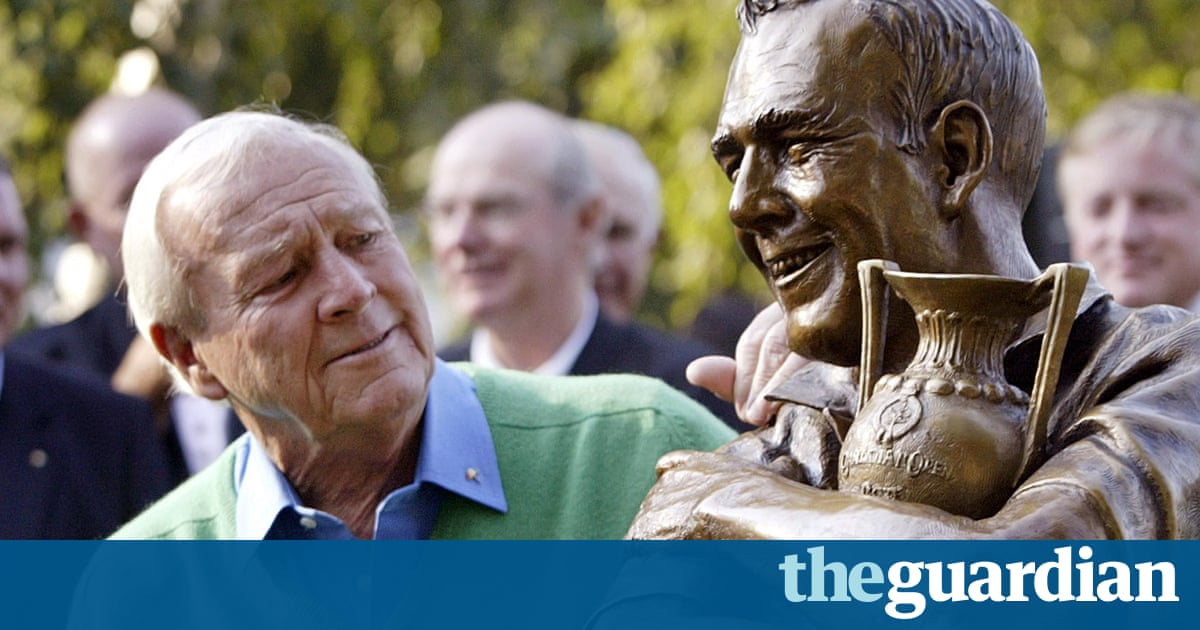
In any list of reasons for the present popularity and high financial standing of golf, the name, and the game, of Arnold Palmer are irresistibly linked.
Palmer, who has died aged 87, was one of the most charismatic golfers ever to play the game, a mans man who was adored by women and a player for whom no play was ever impossible. He got into, and out of, more trouble on the course than any of his championship winning peers, and so outrageous were some of his recovery shots that he quickly attracted a huge following.
The fans, the foot soldiers, who followed him through good or ill became known as Arnies Army and they never deserted him. Even though his golf inevitably declined with age, their fervour for him was undimmed, and even on the US Seniors tour he invariably departed the first tee with a bigger gallery than anyone else. Nor was his appeal confined to occasional fans. Jack Statter, golf correspondent for The Sun newspaper, was once watching his beloved Arnie when he noticed that the great mans caddie had failed to replace a huge divot. He nipped in quickly, trousered it, took it home and eventually grew a complete front lawn from that one small piece of turf. He called it, proudly, Palmers Piece.
Such devotion was inspired by the obvious passion that Palmer had for the game. He had a slashing, dashing style, frequently accompanied by a grin. He would hit the ball hard, the finish to his swing resembling a field athlete trying to break the world record for the hammer throw. It was not a swing that could be guaranteed to keep the ball out of the trees, nor did it. Jim Murray, the late and great Los Angeles sportswriter, and a big fan of Ben Hogan was one day watching Palmer when one of his drives finished in deep rough. According to Murray the ball was in a pile of twigs and leaves and I think there was a dead squirrel and a beer can in there too. Anyway, Palmer walked over and stared down at his ball. Then he saw me standing there and asked: OK wise guy, what would your idol Hogan do here? I told him: Hogan wouldnt be here. Palmer laughed and hit the ball onto the green anyway. Trouble, he once said, is bad to get into but fun to get out of. I suppose theres a place to play it safe but as far as Im concerned its not on the golf course.
Palmer was one of the few men to have given a word new meaning in golfs lexicon. In 1960 he won the US Masters at Augusta by finishing birdie, birdie, birdie. Almost all the sportswriters referred to Palmer charging through to the win, and he duly became famous for his final round finishes, the Palmer Charge.
Only two months after that Augusta win, he also won the US Open and again the charge was in evidence. After three rounds it looked as though he was without a chance, and before the final round he was discussing his prospects with a sportswriter friend, Bob Drum. What, wondered Palmer aloud, would a 65 do for me this afternoon? Drum, a big, burly and blunt man, was dismissive. Nothing, he said. Palmer, stung, went out and drove the first green at Cherry Hills, Denver, a hole measuring 346 yards. He got to the turn in 30, came back in 35 and won what was to be his only US Open. He won the Masters four times, in 1958, 1960, 1962 and 1964, and his seven majors were completed by winning the Open championship twice.
Palmer was rightly credited with reviving the almost moribund Open by playing in it for the first time at St Andrews in 1960. Few Americans thought it worth their while to come and play in the oldest of golfs major championships, but Palmer decided otherwise and encouraged many of his compatriots to make the trip as well. He was runner-up in 1960 and then won twice in succession, in 1961 and 1962, at Royal Birkdale and Troon respectively. The impact was immediate and immense. Prior to Palmer, only two Americans had won the Open since the end of the second world war: Sam Snead in 1946 and Hogan in 1953. In the years 1961-81 they won 14 times, by which time the Open had become the most cosmopolitan, and arguably the most influential, championship in the world.
Palmer was born in Latrobe, a small industrial town in western Pennsylvania, to Deacon, a golf professional at the Latrobe Country Club, and his wife, Doris. He began playing at Latrobe at the age of four, started caddying at 11, and was winning big local tournaments in his teens. He started studying at Wake Forest College (now University), but was badly affected by the death of his room-mate Bud Worsham in a car accident, and left college during his senior year to begin a three-year stint with the US Coast Guard, mainly in Cleveland, Ohio, where he felt he could rethink his life. After finishing with the Coast Guard he worked as a salesman in Cleveland and rekindled his interest in golf, winning the US Amateur championship in 1954 and turning pro the same year.
The next decade was one of heroic achievement, and though Palmers last win in a major came in 1964, his influence on the game remained undiminished. He continued winning other big tournaments in the US until his last victory there in 1973, and his last win in Europe was in 1975. He also ran his own tournament on the US tour, the Bay Hill Classic, which, because of his reputation, attracted fields as good as could be found outside the majors. The programme for that event, held in Orlando, Florida, carried advertisements for products endorsed by Palmer, ranging from cans of oil to tractors, from Cadillacs to Rolexes, from private banks to batteries, and he was making even greater sums of money on the back nine of his career than he did on the front.
For all his fame, however, Palmer was a modest man. From time to time people tried to get him interested in politics, and it was seriously proposed, at the height of his popularity, that he run not just for governor of Florida but for the US presidency. He never for a moment considered such nonsense, for he was a man much happier in his den or his workshop than in any high office.
In his den he had a Rolling Rock beer dispenser, well used when friends called round, and in his workshop he had all the tools any old-time club professional ever possessed. He was never happier than when tinkering with clubs, re-gripping or re-whipping an old set, altering a club loft or adding some lead strip. Some who saw him in these surrounds suggested he would have been happier in his life being the club pro his father was before him. But that viewpoint ignored the fierce competitive instinct which, while it consumed him, always remained well-hidden.
There was no better example of that instinct when the draw brought him and Jack Nicklaus together for the final round of the 1980 Masters. At that point Palmer had not won a tournament for five years, and Nicklaus, his friend and great rival, was the reigning US PGA champion. It should have been no contest. But Palmers wife, Winnie, knew better. Arnie plays better when hes got something like this to light his fire, she said. Palmer, whose reaction on hearing the draw had been to roar Ill whip his ass, went out and shot a 69 to Nicklauss 73, finishing fifth. In his previous 18 attempts at Augusta he had failed to break 70. Palmer had a long love affair with Augusta, and when in January 1997 he learned that he had prostate cancer, his first reaction was to ask whether, if he had the surgery immediately, he would be fit to play at Augusta in April. The answer was yes, and he was.
Altogether Palmer won 73 tournaments worldwide, including more than 60 on the US tour. Only Snead, Tiger Woods, Nicklaus and Hogan are ahead of him in that department. Twenty-nine of his victories were in the period 1960-63, which led eventually to him being named Associated Press athlete of the decade for the 60s. He appeared in six Ryder Cups from 1961 to 1973, playing in 32 matches and winning 22, and was twice a Ryder Cup captain in a playing role in 1963 and a non-playing capacity in 1975, winning both times.
He entered his last US Open at Oakmont, in Pennsylvania, in 1994 40 years after first playing in the event and his enthusiasm and longevity is demonstrated by the fact that the gap between his US Amateur championship win in 1954 and his US Senior Open victory in 1981 was 27 years. Perhaps no professional ever loved the game more. Many of the top players cannot bear to play unless there is a competitive aspect, and a round with friends for pure enjoyment is unthinkable. But Palmer played for the joy of it, and in his communication of that fact lay the secret of his incredible popularity.
There was an occasion at Bay Hill when he and the then emerging Woods found each other on the practice range at the same time. Palmer asked Woods if he was enjoying life on the tour and Woods replied that he was, because, you see, the thing is that I love to play golf. Palmer smiled and replied: Well, thats good. I know something about that. Its a problem Ive had for about the last 60 years.
Winnie (nee Walzer), whom he married in 1954, died in 1999. He is survived by their two daughters, Peggy and Amy, and by his second wife Kit (nee Gawthrop), whom he married in 2005.
Arnold Daniel Palmer, golfer, born 10 September 1929; died 25 September 2016
David Davies died in 2008
source http://allofbeer.com/2017/11/02/arnold-palmer-obituary/